

048: Back to jail
Singing for inmates and wondering what's down all those other hallways.

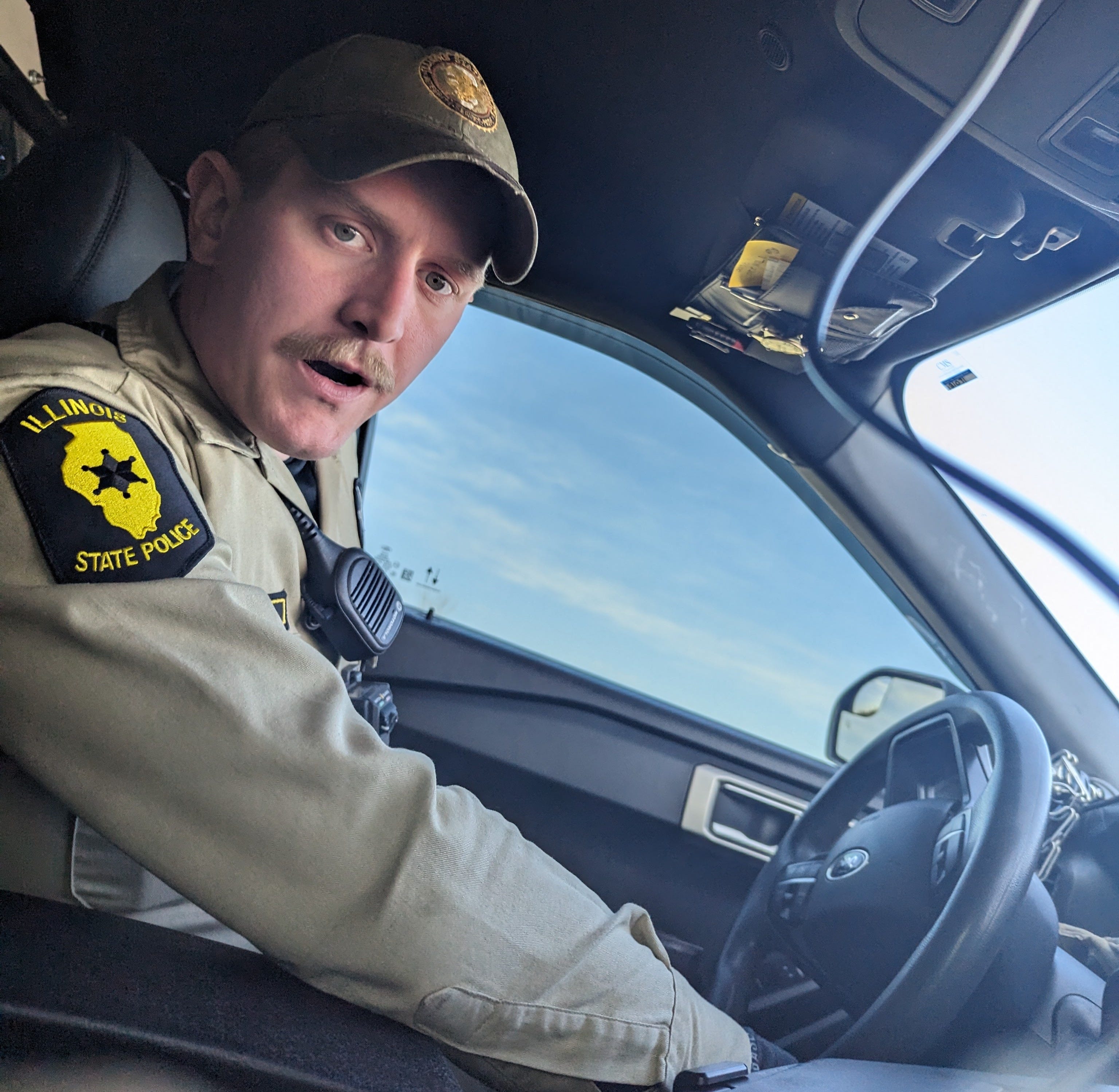
For starters, here’s a picture I took of a cop in an Illinois state cruiser on a road trip when I got pulled over for allegedly going over the speed limit. (I deny this allegation!!) He wanted me to pull up proof of insurance, which you’re not required to have a hard copy of in Massachusetts, so I had to sit and login to GEICO and it took forever because GEICO was like “why are you logging in from Illinois? Is this really you?” so he told me to come sit in his car because it was whipping winter wind and he was about to get blown into traffic. This is an essay about jail and I figured this is the only appropriate usage of a photo like this lol.
A few times a year, I pay 25 cents to lock my car keys and phone up in a green locker, walk through a metal detector, get patted down, and walk through a series of airlocked hallways with remote-controlled doors powered by unseen officers pushing buttons in some distant control room.
I go down the beige-tiled hallway until I reach the junction where the tiles to the left are blue and the tiles to the right are red. I follow the red tiles to another beige hallway, wait for the door to slide open, wait for keys to unlock another door, and finally, I’m in the fluorescent-lit library of the county jail.
They’ve redone the library since I was last here – I’ve been coming here for years – and the walls are palest seafoam green, contrasting oddly with bandaid-colored window trim and the steely semi-reflective window film that mostly blocks the view into the hallway. The beat-up shelves are the same, packed mostly with books from the 80’s and 90’s, although there are some creative writing class staples now: Anne Lamott’s Bird by Bird, some Joan Didion, some David Sedaris. The computers are new, as are the folding tables, the black vinyl chairs, and the big TV cart that dominates the room.
At the end of the room is a whiteboard, bolted deeply into the cinderblock wall. At the top, someone has written What is justice? in dark brown marker. I set up a chair in front of the board, What is justice? bold above my head when I sit down.
I’m dressed modestly, although the deep red of my cardigan is pushing it, if I’m to believe the officer who patted me down. My nose ring is out, replaced with a nearly-invisible clear glass stud. My hair and makeup are simple. It’s the antithesis of how I usually prepare for a show: removing embellishments and embracing simplicity: a red cardigan, unripped plain jeans, flat black shoes. I’m even wearing my one bra, because nipples are forbidden. Nipples and accepting gifts and sharing personal information. Makeup and physical contact. Tight garments and interesting shoes. I get it. Last time I was here there was an hour delay because of a fight caused when one of the women, having yard time, flashed a man in one of the classrooms. He went back to his pod bragging about seeing tits and the shit hit the fan.
After ten minutes, I start to see shadows moving through the window film. A moment later, fifteen men filter into the room, greeting me as they enter. They’re wearing green scrubs, which tells me that they live on a green-tiled hallway and followed green, red, then beige to reach me. The youngest one looks like a teenager. The oldest might be seventy-five. One of them, in the front row, has a word tattooed across his entire face in big black letters, and a nervous way of moving his mouth.
I play some songs, talking about my songwriting process and my inspiration between each one. There are always a lot of questions. The guy whose mouth keeps twitching asks how the movements of my own mouth produce certain sounds. Some of the guys were here last time I played, around six months ago. Most of the faces are new, but I never know if it’s because they’re new inmates or if they simply didn’t sign up to see me play last time I was here. Sometimes they tell me that they used to make music, on the outside.
“I loved being on stage,” one man says. “I hope I get back out there.” A murmur kicks up in the group, and one man reaches forward to clap the guy on the shoulder.
“You will, man,” he says.
“You should come back tomorrow for karaoke!” one inmate says to me, his face lighting up. “It’s in our pod!”
Another guy tells me he’s had a hard time singing since getting in. “My voice is always gone.” I’ve played in the pods before, the two-story windowless living spaces where sound balloons up and out and noise is constant. When I play in the pods, the sound of my guitar gets swallowed in an instant and my voice floats away like a thread. It’s an easy place to lose your voice, alongside everything else being lost at the same time.
One man asks for an opera song. I race through the lyrics of one in my head – if I had my phone, I could just look it up. I sing The Sun Whose Rays from The Mikado, standing up, and suddenly I realize that I’m shaking, hard, and I feel like I might faint. My voice fills up the concrete room and swirls around like hookah smoke. I sit down as soon as I can when I’m done, wondering why I feel so overcome. The man who requested opera is beaming.
“That just made my whole stay here worth it,” he shouts and I feel like I’m floating.
I play two songs about my late mother – the one about letting things go, and the one about building myself back up again after losing her. In the back row, the young guy starts crying, looking up at the ceiling to keep his tears from falling. In my peripheral vision, I watch his face get shiny. The men around him glance over one time and one time only when they first hear him sniff; then they look away with gentle indifference or focus, giving the young man the only privacy they are able to afford one another. After those songs, I take more questions – the conversation always flows naturally in and out of songs.
“So, is your grieving over?”
“It’s never over,” I say. “I’m just growing around it.” Someone else in the room is weeping, now, too. I love playing at the jail for so many reasons, but one of the reasons is that it’s a place where I am intimately reminded of the fact that I never know what’s going through someone’s mind. A jail like this one is meant for stays less than five years. The range of crimes that could land one there is limited in many ways. But the unspoken contract between us is that we all know that the men are in the room due to crimes. From our very meeting, I know that they hold a secret that has shaped their lives and brought them to this moment, to meeting me in captivity.
It’s easy to think that people on the outside have no secrets, that they’re exactly as they appear to be. But I would propose that those of us living on the outside may have more secrets than those on the inside. To be on the inside is to know without a shadow of a doubt that the people around you are there because they have done something. On the outside, the reality of things we’ve done – be they shameful, illegal, hateful, pitiful, or desperate – is concealed behind the plausible deniability we call decency. In the jail, one of the many veils through which we see one another falls. It’s just one, but it is a veil that conceals fears about goodness, about rightness, and about morality.
There’s no such thing as being too good or too smart or too moral to go to jail. Part of what makes this country what it is is that we have a long, storied history of using incarceration and slavery (both historical and contemporary) as political weaponry, as punishment for dissident action, as a threat to those who step out of line, and as a humiliation and subjugation tactic used against those who are poor, uneducated, traumatized, abused, disenfranchised, desperate. It’s a part of the American story and a part of the American arsenal.
I think a lot about goodness. I wonder if I’m a good enough person. I wonder if I’m a good enough sister and spouse and musician and writer and friend and worker, and I drive myself to desperate places to make it all work. This jail seems good, as jails go: they work to have every inmate complete a new level of education, to take parenting classes and attend therapy and earn enough money to secure a place to live. They help with job placement. Recidivism is lower than average there. But perhaps I’m asking the wrong question when it comes to goodness.
Perhaps the real question is does goodness matter? Does an inmate’s time in jail mean anything about how he is as a father or coworker? Does the jail bringing musicians in make it any less a part of the modern slavery machine? What does it mean for me to be in these spaces, in these institutions, in these rooms with people who have made desperate mistakes and people who have done terrible deeds alike?
I don’t know if I need to think on that scale. Maybe that’s the problem.
“Father’s Day will be three years since I lost my dad,” one man says to me in that brightly-lit pale seafoam library. His voice begins to tighten. “What you said about creativity – about trying to be creative even if you’re not good at something –” He starts tearing up so of course I do as well. “I guess it’s good to remember that it’s really just about expressing yourself.”
Ten minutes later, the men are lined up facing the wall with their hands on the cinderblocks over their heads while the CO pats them down to make sure no books, computer cables, or other contraband items are leaving the library. I wait in the hall looking like an elementary school music teacher with my glasses and guitar case and notebook. The men wave and thank me as the remote-control door slides open. They’ll turn left, down the beige hall, then the red one, then the green one before getting locked back into their pod for what will likely be the rest of the day.
Before I leave, the CO turns back and gives me a thumbs-up. “That was awesome!” he enthuses. I step into the hall with him and the door slides shut.
I make my way down the main hall through a few more doors, always waiting for the one behind me to close before the one in front of me will open.
Right before I’m in the lobby, I look to the right and see a young man in red. I’ve never played for people from the red pod. His hair is dirty blonde and his hands are cuffed behind his back. He’s with a short man wearing a nametag that reads “VISITOR: LAWYER” in black letters. The inmate grins at me and jerks his head to the side to swish his bangs out of his eyes, the way teenagers do. It takes me by surprise, so I grin back and say “hey,” through the glass. The lawyer looks at me sharply.
The door in front of me slides open. I step through. It slides closed. Then the guy from the red pod’s door opens. He and his lawyer step through. The door closes. The next door opens, and they are swallowed into the labyrinthine building.